
Challenges in Steel Manufacturing
Without steel, society as we know it could not function. The alloy is embedded in nearly everything that makes modern life possible: from the bridges and highways we drive across to the cars and airplanes we travel in, not to mention the homes and offices where we live and work.
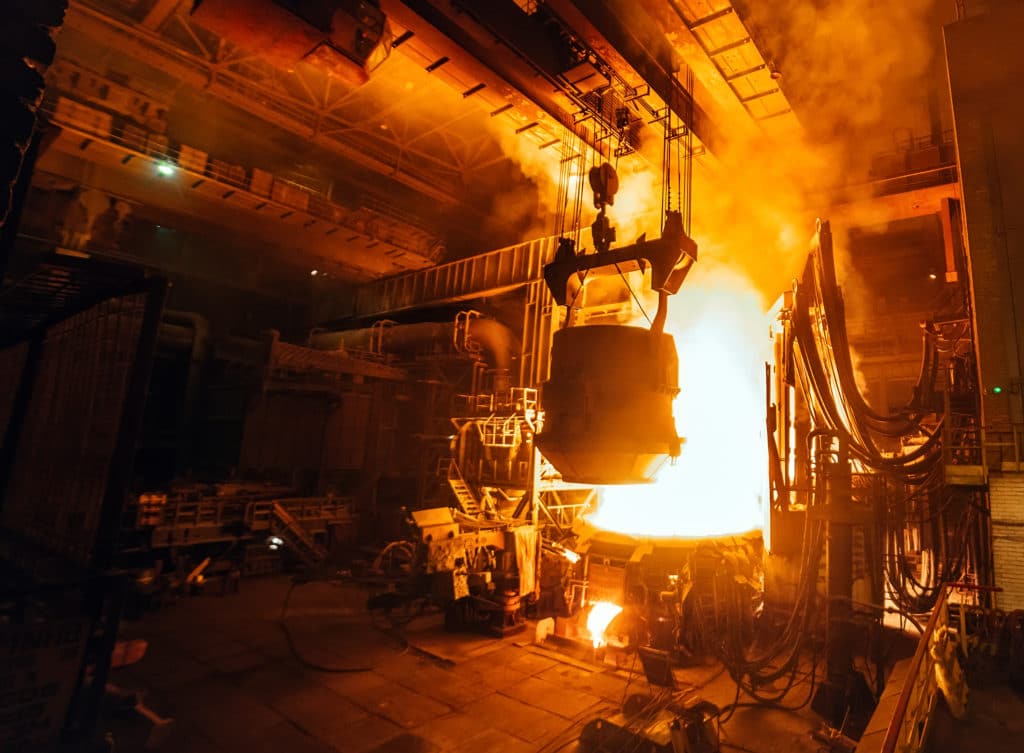
But meeting the rigorous demands of steel production is no easy feat. Steel mills operate under extreme conditions. Temperatures inside a blast furnace can climb to 4,000°F and beyond. Hot rolling processes register near 1800°F. The list goes on. Sparks fly and steam explosions are a concern. In this environment, materials degrade, service life is shortened, and corrosion is exacerbated.
Unexpected power outages and equipment failures can halt operations, put personnel in harm’s way, and shrink margins.
Estimates suggest steel manufacturers spend close to $4 billion annually on maintenance—$1 billion of which is due to unplanned events. [1]
Using equipment that won’t fail under pressure is non-negotiable. When selecting a hose for steel mill operations, metal stands out as the superior choice.
Steel Manufacturing Applications for Metal Hose
Steel mills rely on durable metal hoses to perform in high temperature environments throughout their operation.
In both basic oxygen furnace (BOF) and electric arc furnace (EAF) operations, lance hoses are used to inject materials like oxygen into the molten metal. These hoses must be able to withstand extreme heat and pressures, all while remaining flexible since the apparatus to which they are attached swings in and out of the melt. Metal hose checks the box for each of these requirements.
Once the molten metal is poured from ladle to tundish to mold, it is set into the casters that will form its shape. Here, cutoff torches move side-to-side from above to cut the semi-solidified steel into desired lengths. With temperatures climbing to 1000°F and beyond, the machines depend on cut-off torch hoses that can efficiently deliver oxygen and fuel gas.
Next, the material must be carefully cooled, a process in which precision is everything. The rate at which the water is delivered directly influences the physical properties of the finished steel. Our water cooling hoses for steel mills are uniquely suited to the task, providing safe, reliable transport of cooling water. Beyond cooling, hoses are also used to descale, wash, and condition equipment as part of good preventative maintenance practice.
Lubrication lines keep production running smoothly and on schedule. These components deliver oil or grease to bearings, rollers, gears, and other moving components, reducing friction and preventing corrosion. Thanks to their flexibility, metal hoses can bend and adapt to connect to equipment in hard-to-reach areas.
Material Considerations in High-Temperature and Flammable Environments
Steel manufacturing processes operate at very high temperatures and depend on equipment that can perform under extreme heat. When it comes to a hose for steel mill applications, metal outperforms plastic and rubber in nearly every way.
As is the case with all hose types, higher heat means reduced working pressures. While rubber and plastic hoses decompose and degrade quickly above a certain threshold, metals retain their strength better as temperatures rise. The 300 series austenitic stainless steels have an operating temperature range that far outpaces the competition.

Metal hoses are also far more resistant to sparks, molten splash, mechanical stress, and UV degradation, and as a result, they typically last longer than rubber or plastic hoses, helping to avoid costly shutdowns and frequent replacements.
How Penflex Supports Steel Mill Applications
Penflex offers the widest range of metal hoses used in steel manufacturing. Because we bring a deep understanding of the extreme conditions steel mills operate under, our hoses are uniquely engineered to excel in environments involving intense heat, constant movement, heavy vibration, and high pressure.
Breadth of product line: From delivering cooling water to blowing oxygen onto molten metal, our hose assemblies can support all of your steelmaking needs. Around the world, steelmakers trust Penflex P3 series, available in both standard and compressed pitch for increased flexibility, for use in lubrication lines, caster cut-off torches, and cooling water lines. Our thicker-walled 800 series is ideal for higher-pressure environments, while our high-nickel alloys are chosen for especially corrosive or hot applications. In situations where there is axial movement or a requirement for an uncommon alloy, we offer a full line of expansion joints to support steel mill operations.
Size range: From ¼” to 24”, Penflex’s flexible metal hoses comes in a range of sizes that can be seamlessly integrated into any configuration or space.
High temperature properties: Steel mills require equipment that won’t fail when exposed to extreme heat. With a maximum service temperature of 1500°F, the 300 series stainless steels are engineered to maintain their strength as temperatures rise better than other materials of hose construction.
High working pressures: When metal hoses are pressurized , the hose material naturally expands. The braid functions like a restraining cage, preventing the hose from elongating or swelling and enabling it to operate safely under harsh conditions. Depending on the size and hose series, expect pressure ratings up to 5,000 PSI.
Quality welds: High-quality welds are essential to hose integrity and long-term performance, especially in steel manufacturing applications. At Penflex, we achieve this through a proven process that includes TIG welding and argon purging, which together produce clean, strong welds without compromising corrosion resistance. Our team includes ASME Section IX–certified welders, on-site certified welding instructors, and non-destructive examination (NDE) specialists, ensuring every assembly is tested and leak-tight before it leaves our facility.
Accessories available: For hoses subjected to significant movement, interlocked armor can be installed near the end fittings to prevent overbending and leaks. When slag splashes pose a risk, fire sleeve wraps can be applied to provide long-lasting protection against damage.
Cleanliness requirements: Oxygen lance hoses must maintain exceptional cleanliness, as contaminants like dirt, grease, or debris can pose serious safety hazards. Additionally, keeping the hoses clean minimizes the risk of clogging and corrosion, ensuring optimal performance. To meet these stringent standards, Penflex developed cleaning specification IN-PN-88, a rigorous process designed to effectively remove any contaminants that could compromise hose integrity and function.
Recommended Products for Steel Manufacturing Processes
P3 Series
Available in both standard and compressed pitch for increased flexibility, P3 is used in lubrication lines, torch hoses, and cooling water lines.
800 Series
With its thicker-wall construction, 800 Series delivers the robustness, flexibility, and pressure ratings required for lance hoses found in both BOF and EAF steelmaking.
Inconel 625
With a maximum operating temperature of 1800°F, Penflex 625 Inconel hose may be an appropriate solution in some steel manufacturing applications.
Beyond the Product: The Penflex Partnership
At Penflex, we see every order as an opportunity to continue building our relationship with a current customer–or the beginning of a partnership with a new customer. Our customers count on us not only for a quality product, but also for expertise, responsive service, and resources to help them get the most out of their investment.
Dedicated Engineering Support
Our sales engineers work closely with you from project prototype through delivery, helping define requirements for new products and replacements. A dedicated account manager means you have a single point of contact who understands your business and responds quickly with thoughtful solutions.
Practical Technical Resources
From online calculators and engineering bulletins to in-person and virtual training, we give your team the tools to make informed decisions and the confidence to install, operate, and maintain hoses for maximum longevity.
Full Quality Documentation
On request, we provide complete record packs—including material test reports, leak and pressure test results, and cleaning procedure documentation—so you can meet compliance requirements and maintain full traceability.
Our commitment to service is reflected in our 99% customer retention rate and an average customer relationship of 20 years. We aim to make every interaction count, combining technical know-how with the kind of service that turns first-time buyers into long-time partners.
Footnotes
[1] Baker Hughes. Managing Increasing Cost Pressures in Metal Manufacturing. Retrieved November 18, 2025 from https://www.bakerhughes.com/bently-nevada/blog/managing-increasing-cost-pressures-metal-manufacturing.