
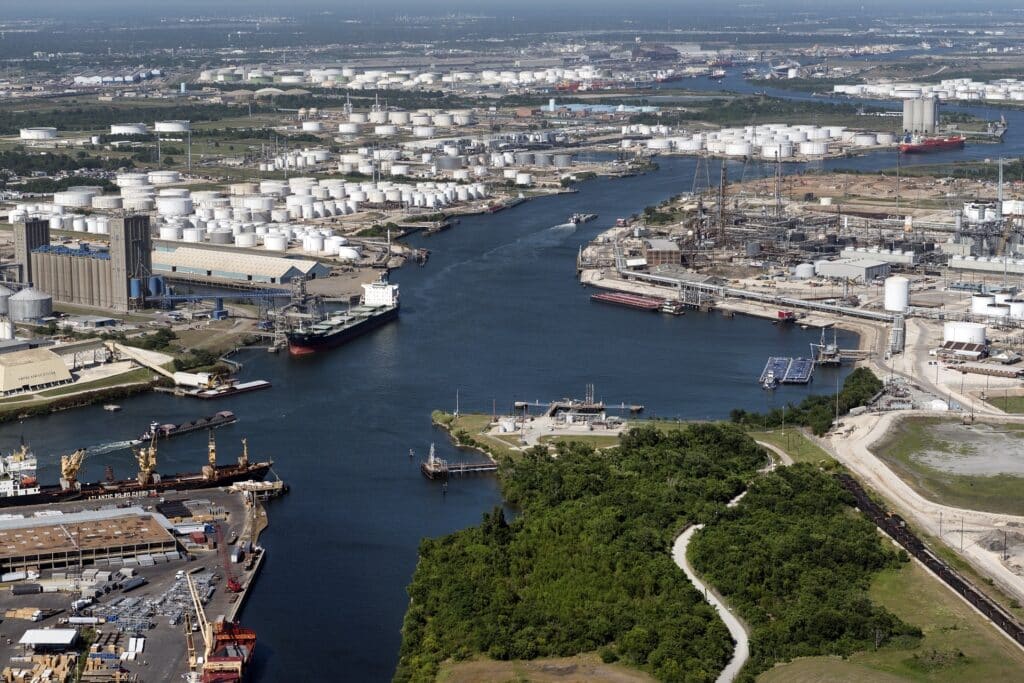
From liquid and bulk material storage and transfer to, in some cases, blending, tank terminals provide important services to a broad swath of industries around the world. Supply chains hinge on them while volatile markets rely on their ability to absorb excess supply and help stabilize prices.
The success of a terminal operation depends on how efficiently product is moved throughout the facility. Delays are costly to the bottom line as well as to a company’s reputation. To support their objective, tank terminal operators depend on robust and reliable piping solutions.
“Liquid terminals are the most important business you’ve never heard of.”
— Kathryn Clay, President, ILTA
Why Use Metal Hose in Tank Terminals
Metal hose fits the bill. Whether installed as a permanent or temporary connection, these flexible components can be found all over tank terminals. Metal hoses are used for loading and unloading ships and barges, sometimes as part of marine loading arms and sometimes as dock hoses. They are also used to connect pipelines to tanks, railcars, and trucks.
The beauty of metal hose for tank terminals is versatility. Compatible with many different kinds of chemicals, hoses can be steam cleaned onsite after one loading-unloading or transfer assignment before being installed in another. Given the variety of media handled by terminals, this is a great benefit.
Material Selection: Metal or Composite for Dock Hoses
Metal and composite hoses are used on docks around the world. Material choice is often a default to what was previously ordered, but it is worth laying out the case for both to ensure you are selecting the right option for your terminal operations.
Metal hoses will last longer than composite hoses. They offer superior corrosion resistance. They handle higher pressures and higher temperatures better. (In some cases, based on the operating conditions, metal hose may be the only suitable option.) Flammability is not a concern with metal hose. And neither is UV degradation.

Traditionally, these benefits come with a higher price tag. However, the changing landscape of international trade and advances in composite technology make cost analysis a consistently wise course of action.
In addition to often being a more economic option, composite hoses are lighter and easier to move around a facility. They do offer some corrosion resistance, though, broadly speaking not as good as metal hose. They can be easier to source as well. With end fittings that are crimped on, an end user could walk into a hose shop and have a dock hose within 10 minutes. Conversely, metal hose end fittings are welded on and will take longer to procure.
Beyond concerns around flammability, degradation, and permeability, the use of PFAS in composite hoses may put these products under scrutiny.
Choosing between metal and composite isn’t about tradition. It’s about aligning your equipment with your operational realities. By considering the full picture—performance, durability, handling, availability, and compliance—you can select dock and terminal transfer hoses that not only meet today’s needs but position your terminal for reliable, safe service in the years ahead.
How Penflex Supports Tank Terminals
Tank terminals have relied on Penflex hose since the company’s earliest days. Images from old catalogs show Penflex interlocked hose being used to unload crude oil from a tanker. Other snaps show Penflex hoses in grain, liquid pesticide, and molasses unloading operations.
While hose technology has evolved–corrugated hoses have largely replaced interlocked hoses in these applications–Penflex has remained vigilant in expanding its product portfolio and service offerings to meet the changing needs of tank terminals.
The benefits of Penflex hoses include:
Broad product portfolio: While many of these benefits apply to corrugated hose, they extend to our interlocked designs as well. Interlocked hoses remain a staple in certain terminal operations, particularly for dry bulk transfer. Penflex offers a wide range of standard interlocked hoses along with our unique M-100 series.
Industry certifications: We can supply U.S. Coast Guard certified metal hose assemblies and are happy to discuss additional certifications as needed.
Corrosion resistance: Resistance to corrosion is one of the main reasons end users choose metal hose. The 300 series austenitic stainless steels are compatible with a broader range of chemicals—and to a greater degree—than most other hose materials. This means metal hose will typically last longer in a corrosive application. It also means terminal operators need fewer hoses to support their product mix.

Beyond considering what flows through the hose, engineers and operators also need to think about the atmosphere. Terminals located near ports are subject to the corrosive effects of marine environments. A robust metal hose will resist environmental corrosion far better than a non-metallic hose or a lighter-duty metal hose with a thinner wall and single braid layer.
Robust design: Terminal hoses face constant handling, frequent relocation between applications, and the rigors of outdoor use. While metal inherently resists UV degradation, Penflex designs go further, incorporating all-metal construction, thicker hose wall, and multiple braid layers to guard against mishandling, abrasion, and both internal and external corrosion.
Leak-tight integrity: In applications where spills or vapor releases pose fire risks, safety is a priority. The impact of a leaky hose on the environment is amplified if the hose is run over the water. So while a leak-tight hose supports an efficient operation, it also ensures a safe one. As the most likely point of chemical attack or manufacturing defect, welds should be scrutinized. At Penflex, every assembly weld is argon-purged by ASME Section IX certified welders. Purging is a proven process that minimizes oxidation, strengthens the weld, and reduces susceptibility to chemical attack. Leak testing confirms our welds consistently meet the highest standards, enabling us to consistently deliver leak-tight hose assemblies.
Longer service life: Combine a robust hose design, corrosion-resistant materials, and expertly executed welds, and you have a flexible piping component built for years of dependable service.
Recommendations for extending service life: Leveraging our experience with terminal facilities, and in an effort to help hoses last longer in service, Penflex developed a handling guide for terminal operators. It addresses these common issues we see with dock and terminal transfer hoses.
- Braid bulging
- Braid wear
- Exposure to the elements
- Extreme over bending
- Hose stacking
- Too-tight protective covering
Recommended Products for Terminal Applications
P4 Series
Penflex’s general purpose hose for use across terminal operations.
800 Series
Heavier wall thicknesses support a robust design well suited for dock hoses.
Interlocked Hose
Penflex’s broad range of interlocked hoses are often used for dry bulk transfer.
Beyond the Product: The Penflex Partnership
At Penflex, we see every order as an opportunity to continue building our relationship with a current customer–or the beginning of a partnership with a new customer. Our customers count on us not only for a quality product, but also for expertise, responsive service, and resources to help them get the most out of their investment.
Dedicated Engineering Support
Our sales engineers work closely with you from project prototype through delivery, helping define requirements for new products and replacements. A dedicated account manager means you have a single point of contact who understands your business and responds quickly with thoughtful solutions.
Practical Technical Resources
From online calculators and engineering bulletins to in-person and virtual training, we give your team the tools to make informed decisions and the confidence to install, operate, and maintain hoses for maximum longevity.
Full Quality Documentation
On request, we provide complete record packs—including material test reports, leak and pressure test results, and cleaning procedure documentation—so you can meet compliance requirements and maintain full traceability.
Our commitment to service is reflected in our 99% customer retention rate and an average customer relationship of 20 years. We aim to make every interaction count, combining technical know-how with the kind of service that turns first-time buyers into long-time partners.