
ENGINEERING BULLETIN #105
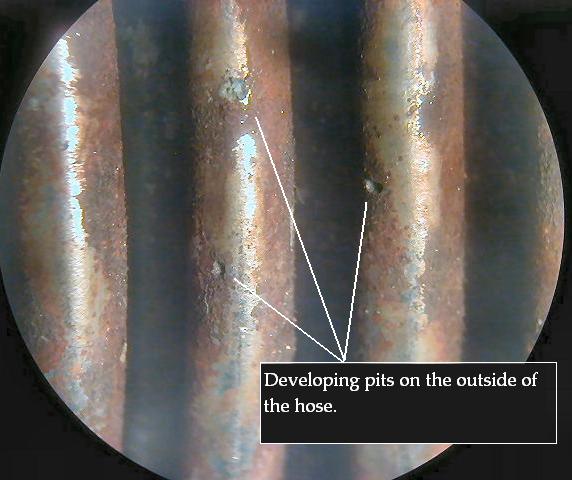
Stainless steel is widely used in piping, heat exchangers, and cooling water systems due to its strength and corrosion resistance, but its performance is highly dependent on water chemistry. Among the most critical variables to monitor are chloride (Cl⁻) and free chlorine (Cl₂) levels, both of which can compromise the protective oxide layer that gives stainless steel its corrosion resistance. As chloride concentrations increase—often measured in parts per million (ppm)—the risk of localized corrosion mechanisms such as pitting and stress corrosion cracking (SCC) also rises, particularly at elevated temperatures or in stressed components. Understanding how these factors interact is essential when selecting alloys like 321 or 316 stainless steel for water and process applications.
What chloride level causes corrosion in stainless steel 304 and 321?
The 304 and 304L (18-8 stainless steel alloys) have been utilized very successfully in fresh waters containing low levels of chloride ion of up to 100 ppm. This level of chloride is considered to be the limit for the 18-8 alloys, particularly if crevices are present. Higher levels of chloride might cause crevice corrosion and pitting. The 18-8 alloys are not recommended for exposure to marine environments which have much higher levels of chloride.
The resistance of the stabilized Alloys 321 to pitting and crevice corrosion in the presence of chloride ion is similar to that of Alloy 304 or 304L stainless steels because of similar chromium content. And therefore 100 ppm chloride in aqueous environments is considered to be the limit for the stabilized alloys, particularly if crevices are present.
What is the maximum chloride concentration for 316 stainless steel?
For more severe conditions of higher chloride level, lower pH and/or higher temperatures, alloys with Mo (molybdenum), such as Alloy 316, should be considered. The Mo-bearing Alloy 316 and Alloy 316L may handle waters with up to about 2000 ppm of chloride.
What levels of chlorine are safe for 304/321 and 316 stainless steel?
Another factor to consider is the amount of free Chlorine (Cl2) (usually derived from sodium hypochlorite) which is added to water (well water, drinking water, swimming pool water, etc.) to kill bacteria. Cl2 (chlorine) is a very potent oxidizer (reason it kills bacteria) and therefore high levels of Chlorine may accelerate chloride corrosion of stainless steels. 304 and 304L, 321 SS may be used for “water applications” with up to 2 ppm chlorine, while 316 and 316L alloys may “take” up to 4 ppm.
How do chlorides damage stainless steel?
Elevated chloride levels can break down the protective oxide layer on stainless steel, leading to pitting corrosion, and under the right combination of temperature and stress, may also initiate stress corrosion cracking (SCC). Understanding how these mechanisms develop—and how operating conditions influence them—is critical when selecting materials for water and process systems.
If looking for information about Chlorine Transfer Hoses, please click here.
Disclaimer: The info presented here has been compiled from sources believed to be reliable. No guarantee is implied or expressly stated here and the data given is intended as a guide only.
